

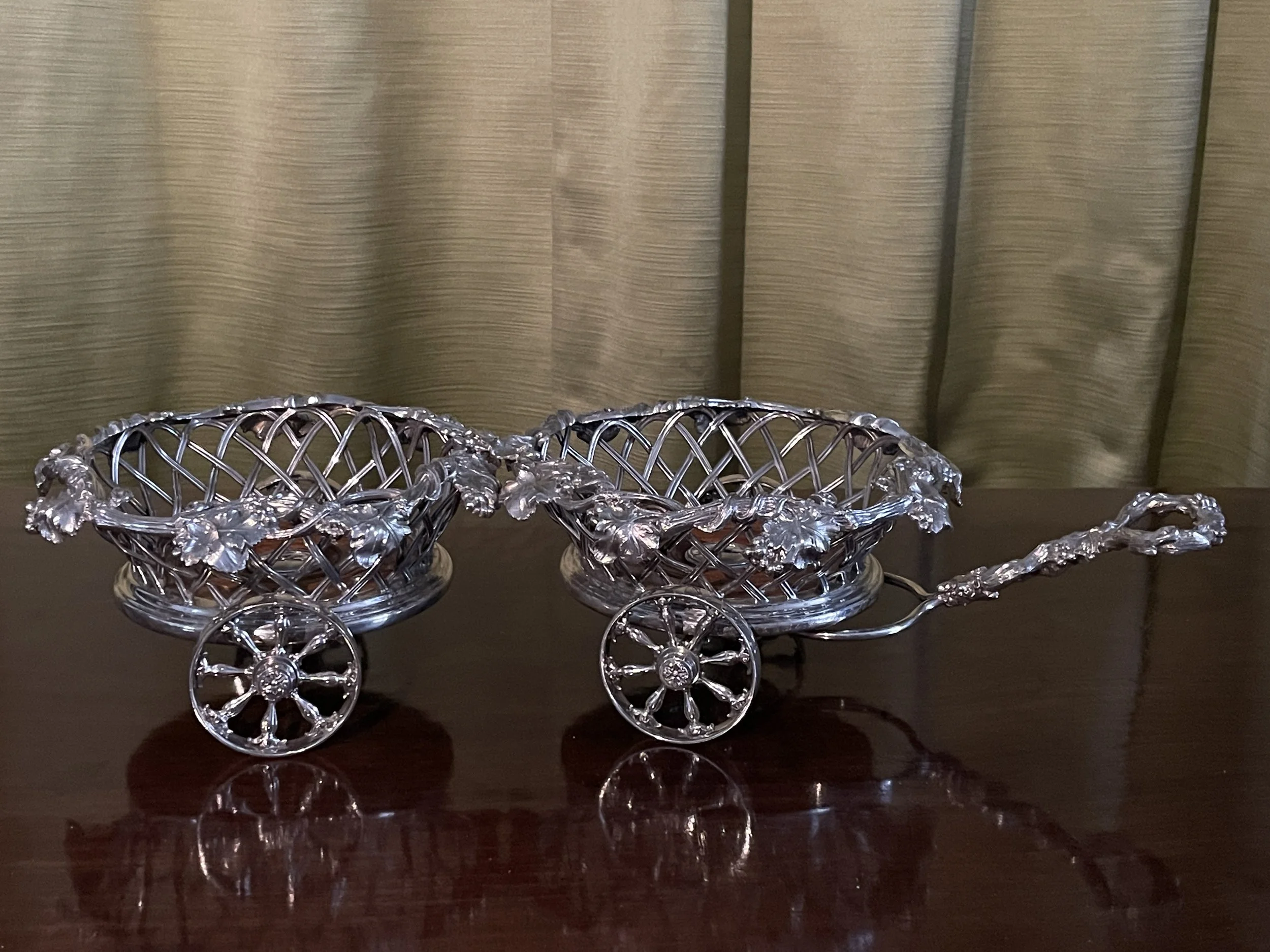
An exceptionally fine and rare mid-Victorian Sheffield Plate Decanter Trolley formed as two open weave baskets topped with cast and finely chased vines, vine leaves and bunches of grape borders, the handle cast to match and mobilised on four classical chariot wide rim wheels with baluster spokes and foliate medallion hubs. The central silver boss to each turned wood base plain as original.
A presentation inscription in copperplate script on the front lower rim reads:- “From WS & CEB to Alfred Cheek Esq as some slight return for a long course of unwearied kindness & attention”
Trolley: Overall Length 19” (48.5cm) Width 7¾” (19.5 cm) Height 4”. 10 cm Internal diameter of each coaster: 4¼" (11cm)
£2,650
The matching pair of coasters formed as open weave baskets topped with cast and finely chased vines, vine leaves and bunches of grape borders.
Coasters: Diameter 7½” (19cm) Height 2” (5cm) Internal diameter of each coaster: 5" (12.5cm)
£1,750
All by Elkington & Co. Birmingham and in immaculate condition throughout.
The decanters are available separately.
Register Interest
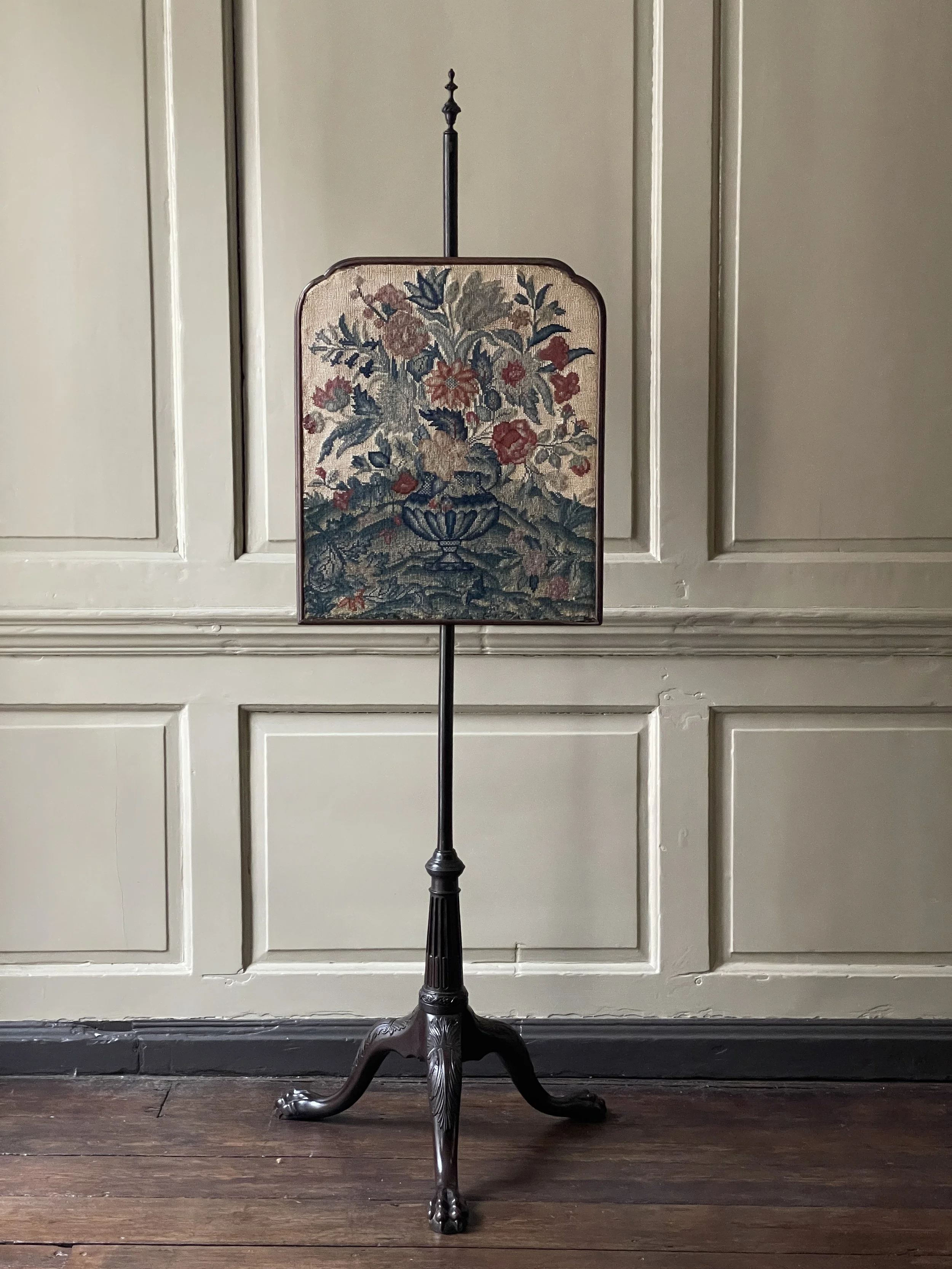
A particularly fine example with tapered and stop fluted stem and flower carved guilloche collar on a fine tripod base. Each leg with bound carved foliage terminating in an elongated claw and ball foot. Circa 1755
23” wide, 23” deep, 68½” high. 59cm by 59cm deep by 175cm high.
The base £2,250.
The exquisite needlework panel depicting a vase of flowers, circa 1735 available separately.
On loan to Benjamin Franklin House, Craven Street, London with framed Chinoiserie panel as shown in the last image. Click here for details.
Register Interest
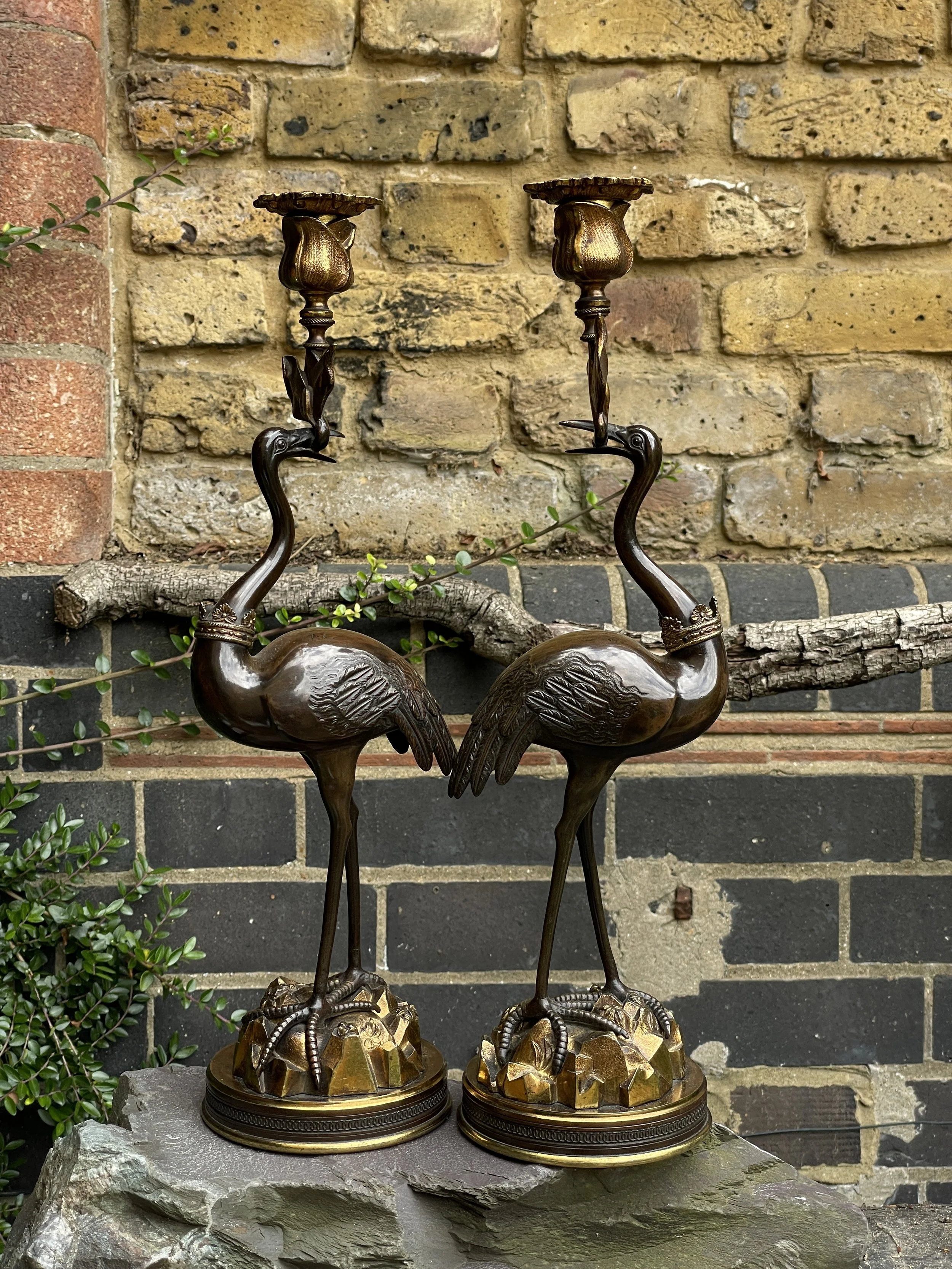
A fine pair of bronze cranes on parcel-gilt rockwork bases, each with a coronet to the neck and holding in its beak an opened oak leaf surmounted by a candle sconce and original drip-pan.
Cranes being emblematic of all the virtues are the heraldic device of several noble families including Gibson of Dublin. Circa 1840
H: 15” (38cm) W: 4.5” (11cm)
£3,850
Register Interest
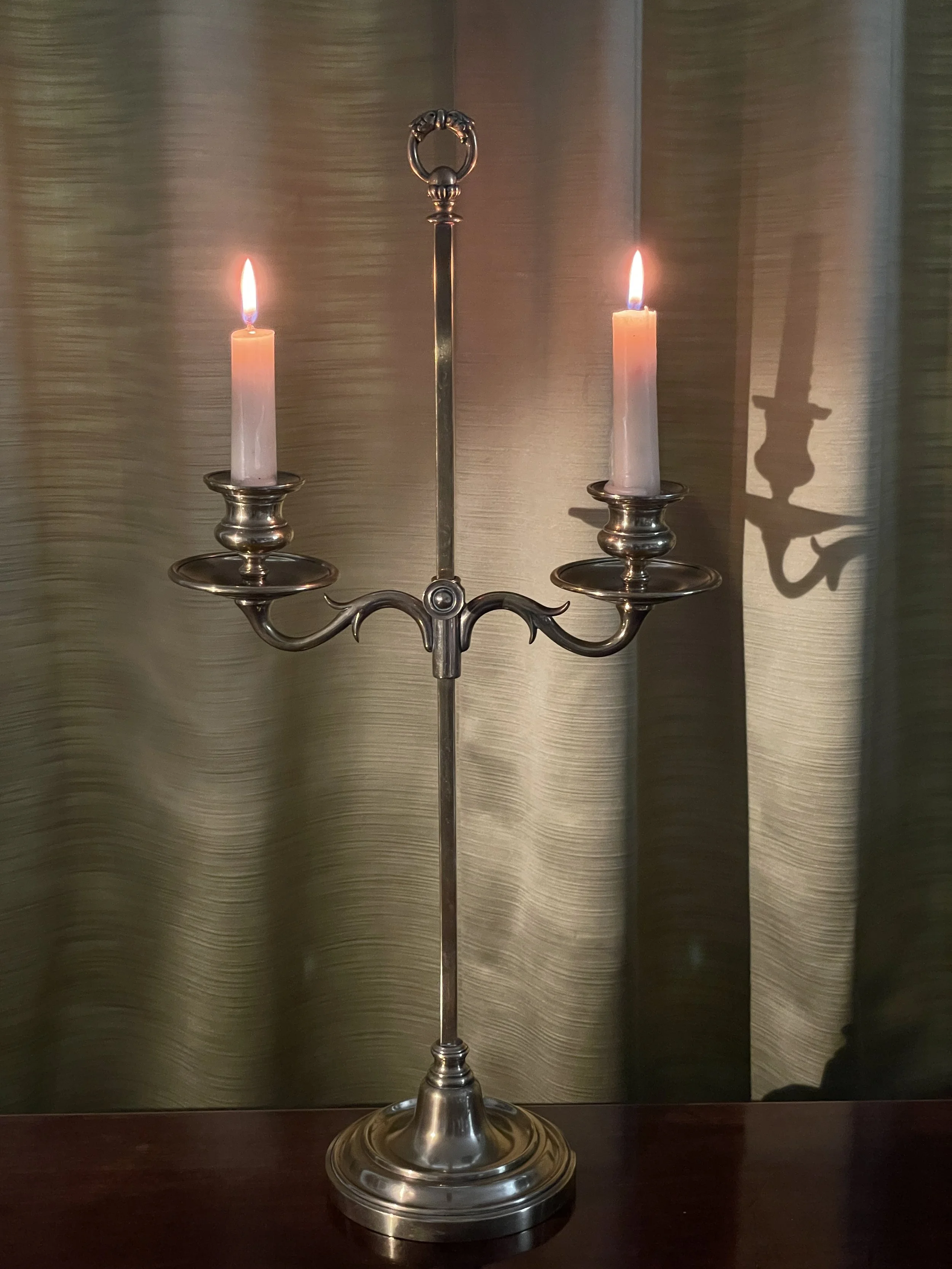
A handsome and most useful Georgian period two branch adjustable brass Table Candelabra, the central square section stem topped with a cast ring handle, on a circular moulded base and supporting two double eared and scrolling arms each terminating in campana shaped sconces and saucer drip pans.
A label to the underside of the base refers to a similar lamp in the American Museum in Bath.
Circa 1760
Base Diameter 5” (12.75cm) Height 21” (53.5cm) Overall width 10” (25.5cm)
Excellent condition.
£1,850
On loan to Benjamin Franklin House, 36 Craven St, London.
Register Interest
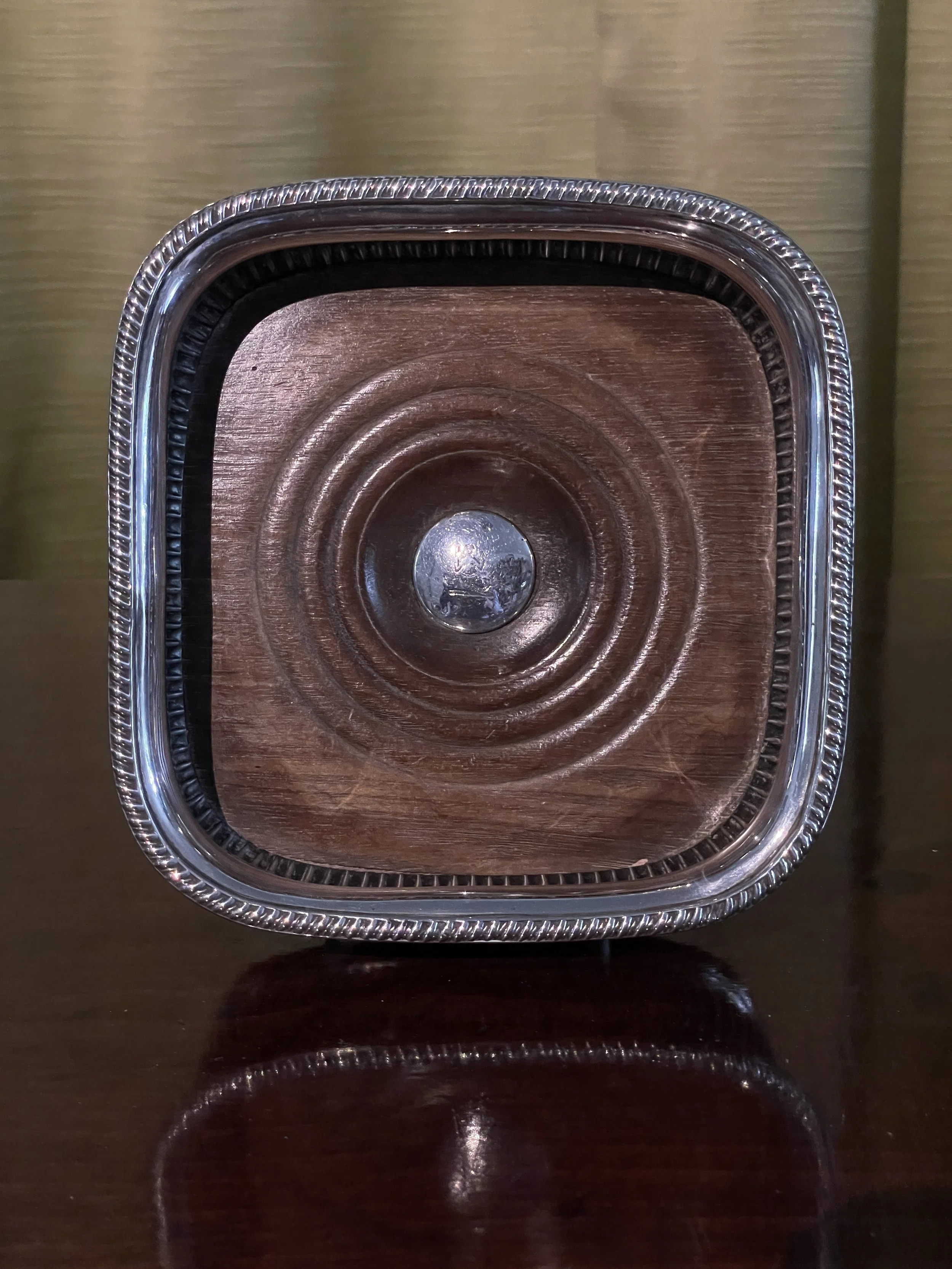
The only Georgian silver Square Decanter Stand we have ever handled, the lower part of the classic baluster body vertically lobed below an everted and spirally lobed border. The central silver boss to the turned wood base engraved with a figure of a mermaid, the crest of the O’Byrne family, immortalised in the song “Follow me up to Carlow”.
Sheffield 1808 by W. Tucker & Co.
Width 5¾” (14.5 cm) Height 1¾” (4.5 cm)
Condition: Excellent throughout. Felt liner to base replaced but not new.
On hold
Register Interest

Numbered 6, this lidded oval canister painted and decorated to depict a Chinese figure with trading goods in front of a ship all within a Greek key pattern border. An oval label to the reverse: "Bartlett & Sons Ltd. Welsh Back. Bristol."
"Japanner of Grocer's Tea Canisters" John Bartlett was born c.1825 in London. By 1852 the firm was called J Bartlett & Son, and in 1880 it was listed at 2 & 3 Welsh Back, Bristol; in 1910 the firm was taken over by Henry Pooley & Son of Birmingham, who were in turn taken over by W &T Avery in 1914.
Circa 1880
Height: 17 inch (43 cm)
Width: 10 inch (25 cm)
Depth: 7.5 inch (19 cm)
Condition: There are a few signs of use and wear commensurate with age. Some areas of painted decoration have been touched in over the years, particularly to the Greek Key pattern. There are some chips and scratches when the lid is removed and a dent to back shoulder, all as shown in photos.
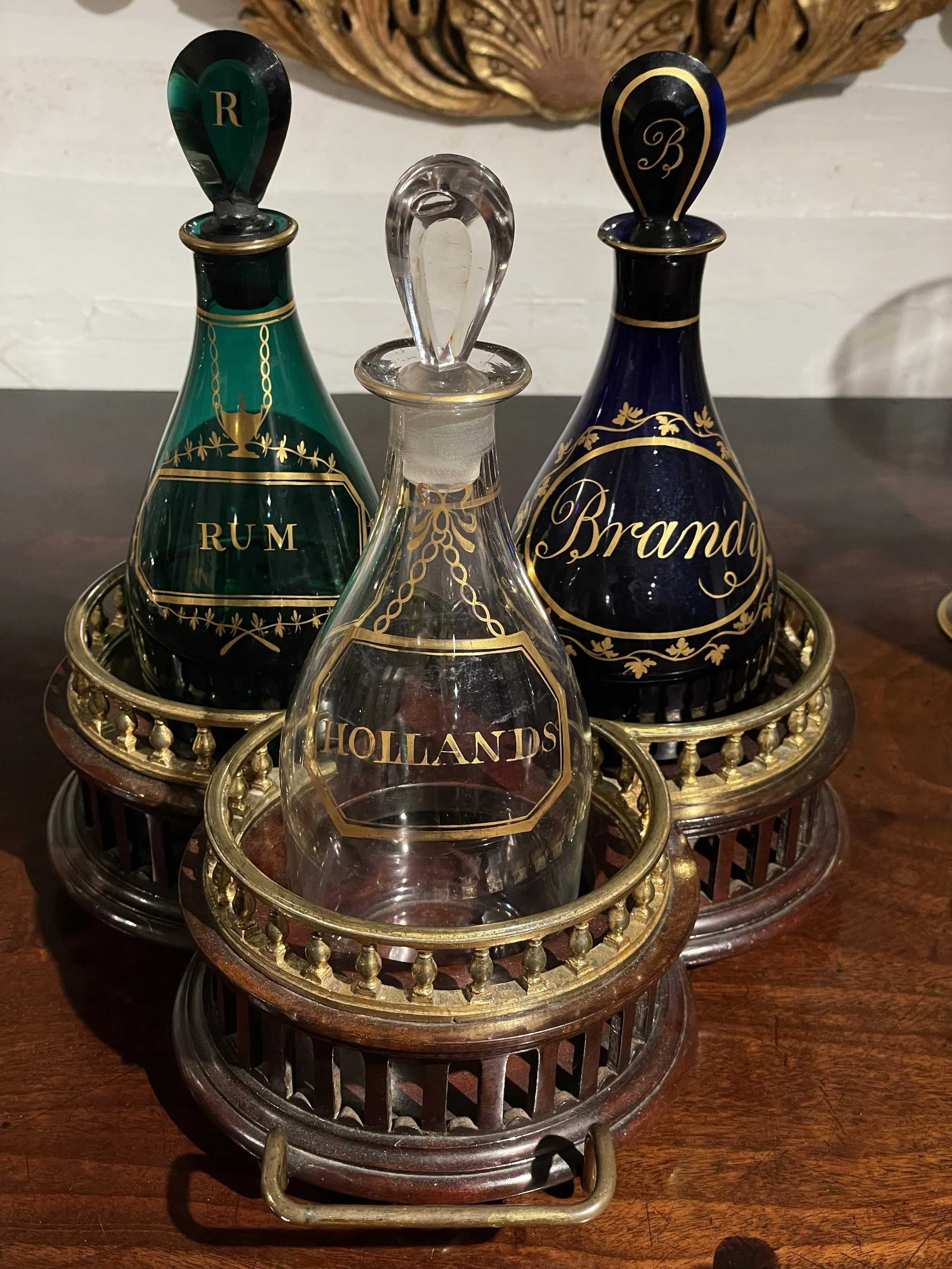
The base surmounted by a gilt metal balustraded gallery with side handles and three bun feet.
Circa 1895
Width overall 13” (33cm) Height 4” (10cm)
£650
Register Interest
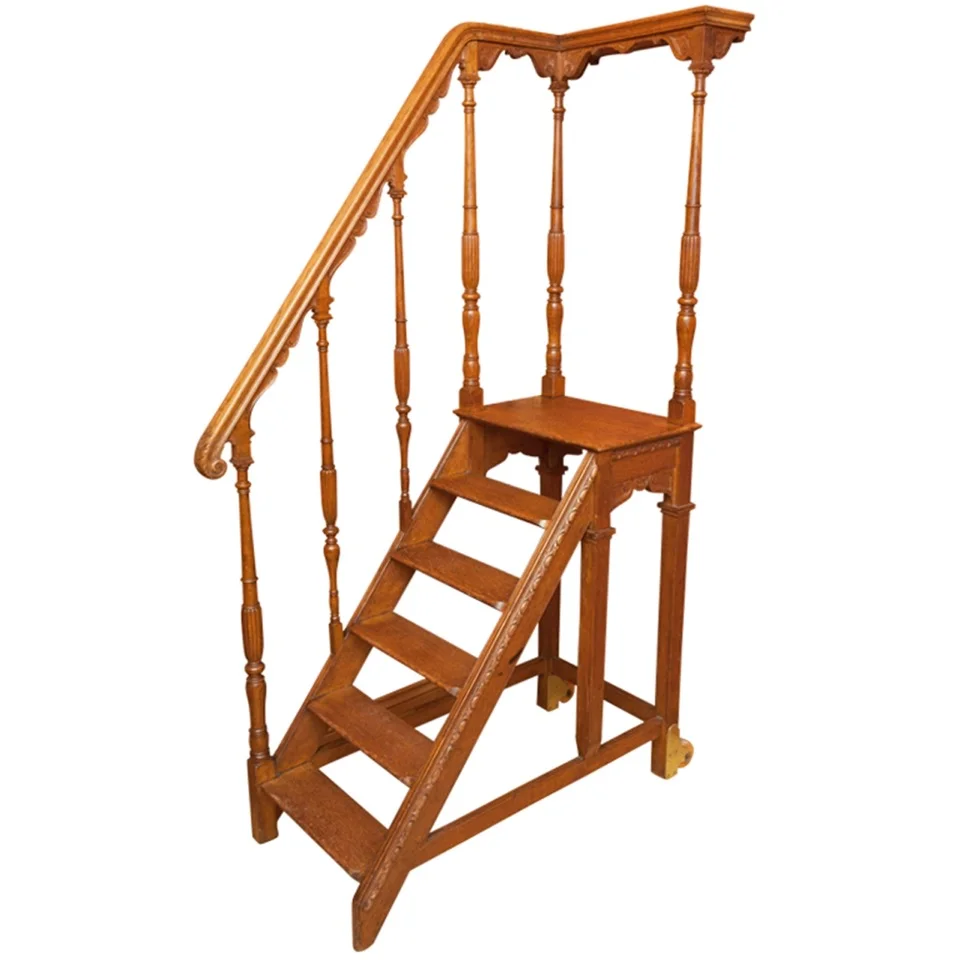
An Important set of Library Steps made in Oak for Gonville and Caius College, Cambridge, circa 1840. Of fine golden colour they display in all carved elements the hand of ecclesiastical as well as secular craftsmanship typical of the first half of the 19th century, with free flowing curves and scrolls executed with flair and a natural feeling for the timber restrained only by the disciplines of the period. In excellent condition throughout they retain the original castors and are surmounted by a book platform as decreed beneficial by Thomas Sheraton.
Circa 1840
Height: 76 inch (193 cm)
Width: 21.5 inch (55 cm)
Depth: 43 inch (109 cm)
£14,500
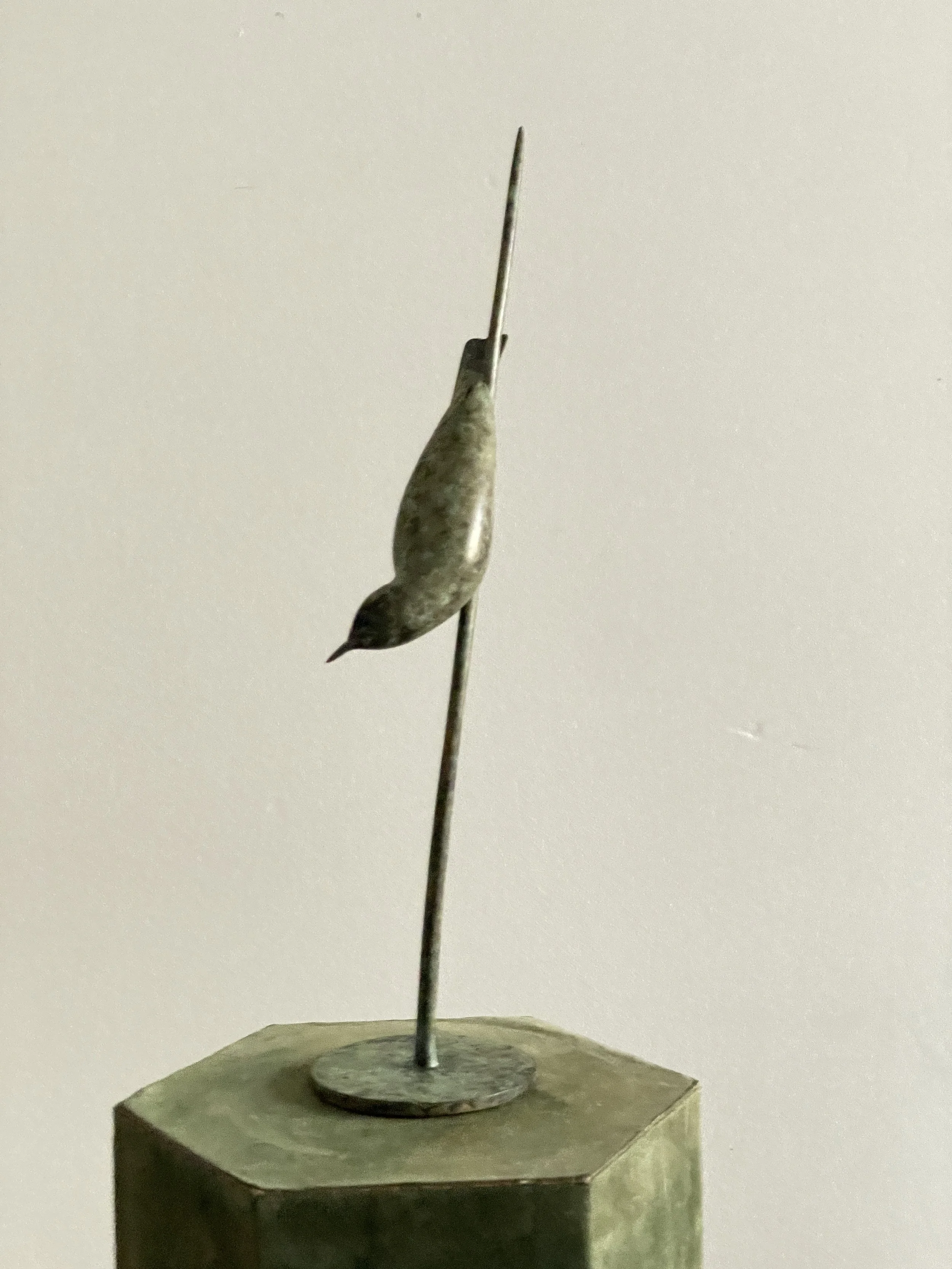
A beautiful example by another extremely skilled sculptor.
Signed and numbered 4 of 15
£3,450
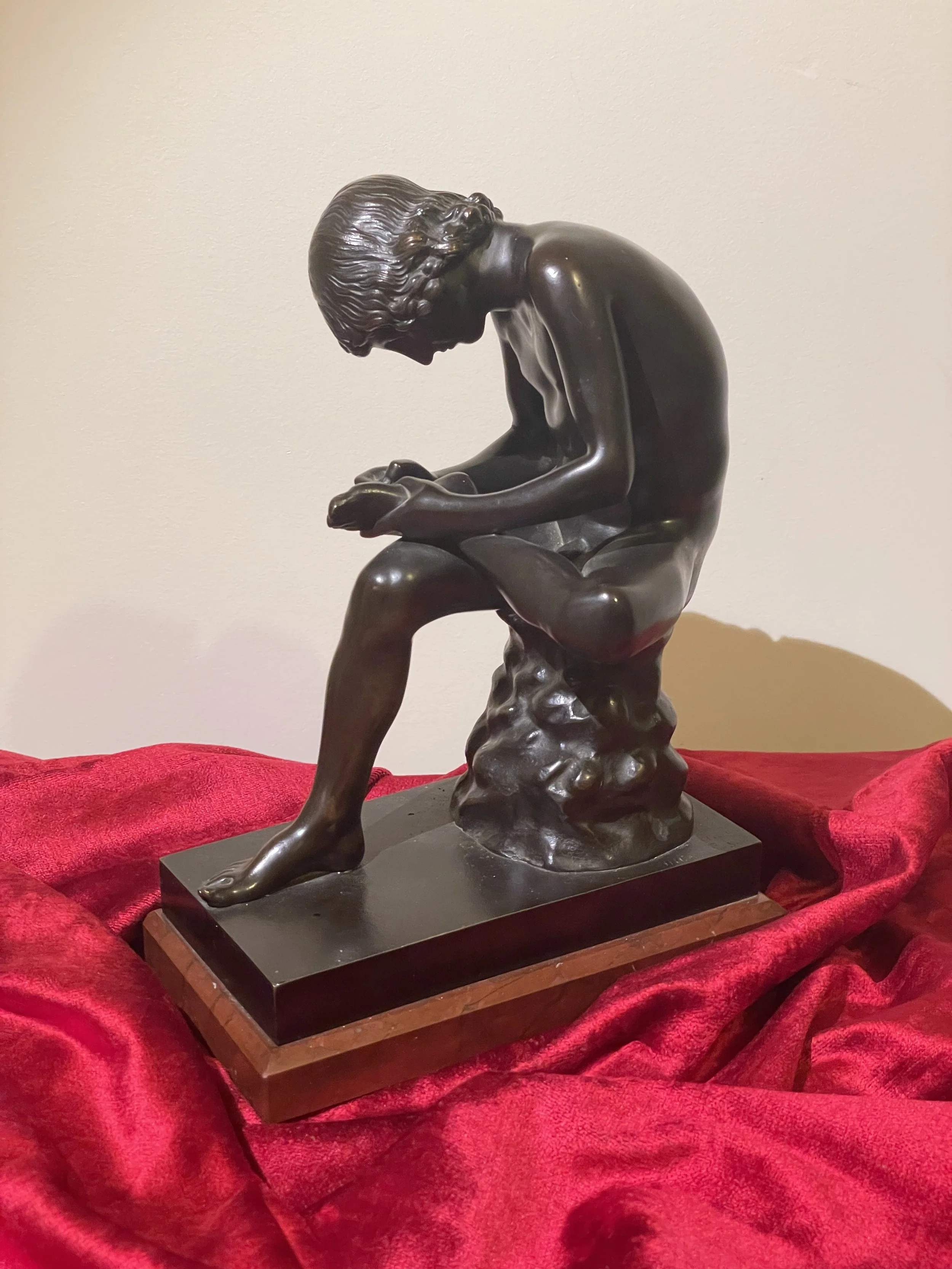
A Grand Tour bronze sculpture of Spinario or Boy with Thorn, also called Fedele or Fedelino, bearing the mark of Aktien-Gesellschaft Gladenbeck, one of the most important foundries in Germany and known for producing high quality bronze castings from 1851 -1926.
The model is of a Greco-Roman Hellenistic bronze sculpture depicting a boy withdrawing a thorn from the sole of his foot, now in the Palazzo dei Conservatori, Rome. There is a Roman marble version of this from the Medici collections in a corridor of the Uffizi Gallery in Florence.
This finely patinated example is raised on a marble base, approx. 9 1/2" 24cm high
Height: 9½” (24cm)
£1,250
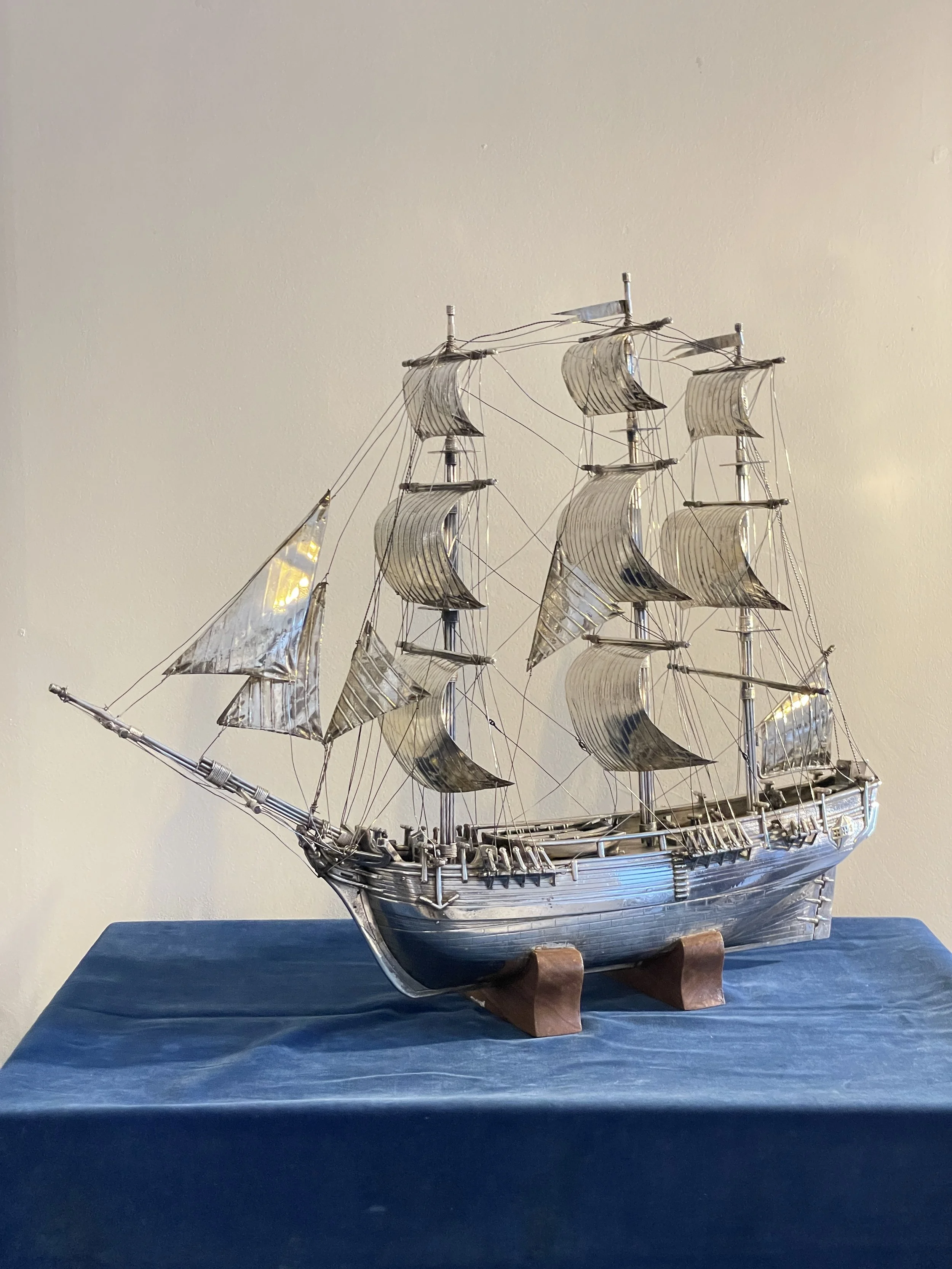
A fabulously detailed silver model of this iconic ship in excellent condition.
Hallmarked: 1889
Length: 20 inch (51cm) Height: 16.5 inch (42 cm)
Beam: 8 inch (20 cm)
SOLD
HMS Bounty, also known as HM Armed Vessel Bounty, was a British merchant ship that the Royal Navy purchased in 1787 for a botanical mission. The ship was sent to the South Pacific Ocean under the command of William Bligh to acquire breadfruit plants and transport them to the British West Indies to provide a cheap food source for the West Indies' large enslaved population. That mission was never completed owing to a 1789 mutiny led by acting lieutenant Fletcher Christian, an incident now popularly known as the Mutiny on the Bounty. The mutineers later burned Bounty while she was anchored at Pitcair Island in the South Pacific in 1790.
Bounty was originally the collier Bethia, which was reportedly built in 1784 at Blaydes Yard in Hull, Yorkshire. The Royal Navy purchased her for £1,950 and subsequently reftted the ship and renamed her Bounty.The ship was relatively small at 215 tons, but had three masts and was full-rigged. After conversion for the breadfruit expedition, she was equipped with four 4pdr (1.8kg) cannon and ten swivel guns.
Source: Wikipedia
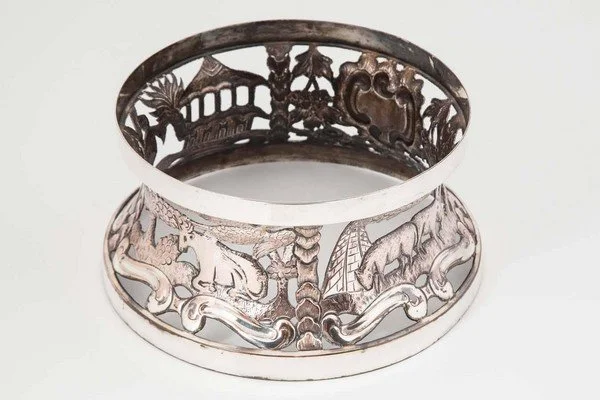
A fine late 18th century Irish silver plate Dish Ring or PotatoRing.It maybe used with a glass liner but originally made to contain a heater lampand support a dish of potatoes.
Circa 1785
Height: 4"/10cm Diameter: 8"/20cm.
£185
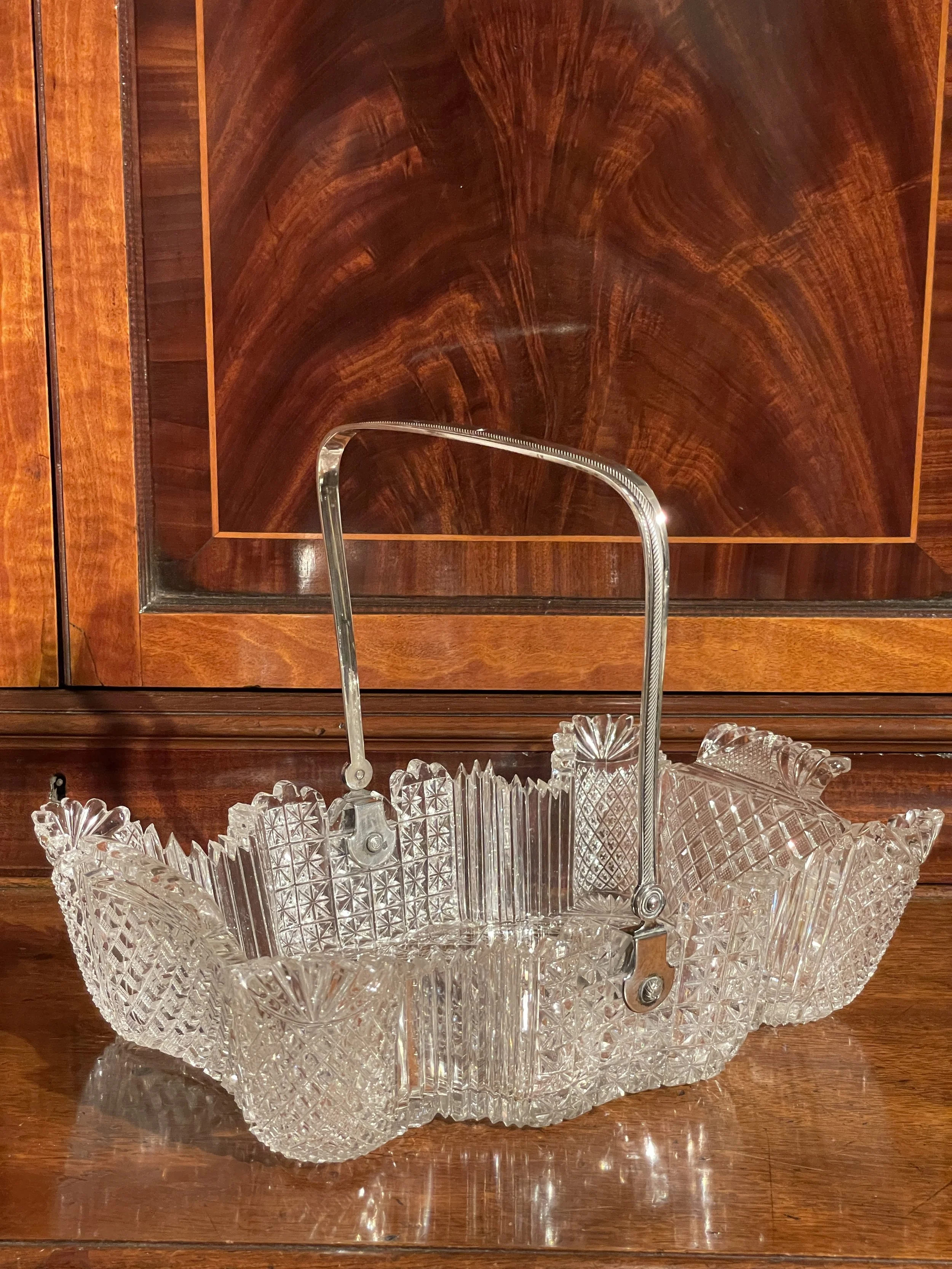
A fabulous early 19th century example with the finest and sharpest hobnail, pointed flute, star burst, diamond and fan cutting throughout. The silver handle hallmarked Edinburgh 1829.
Wonderful quality. Chips to some edges.
Date 1829
Length: 11.5 inch (29cm)
Height: 3.5 inch (9cm) Handle: 17 inch (43cm)
Width:8 inch (20 cm)
£1,250

The everted lip with an ogee moulded edge around a rich patinated surface. The 67 x 68 cm measurement a guarantee of 18th century origin due to natural shrinkage of the timber since being turned.
In immaculate condition, this is the largest tray we have ever seen.
The earliest records refer to trays as ‘Voyders’, used to clear dining rooms during the interval between the meal and the ensuing entertainments, a period known as the ‘Void’ which was also used to describe the pudding, taken informally with a gentle stroll.
When ‘New French’ replaced ‘Old French’ by 1600 the word for clearing the room was ‘Desert’ as was the pudding while adopting the Old English word ‘Trig’ for a wooden board.
Circa 1765
Diameter: 26” x 261/3” (66cm x 67cm)
£1,850

A late 19th century Cantonese punch bowl vibrantly decorated throughout with alternating panels of foliate sprays and Court scenes depicting noblemen and ladies at leisure.
Circa 1890
Diameter: 15” (38cm) Height: 6” (15cm)
£1,250
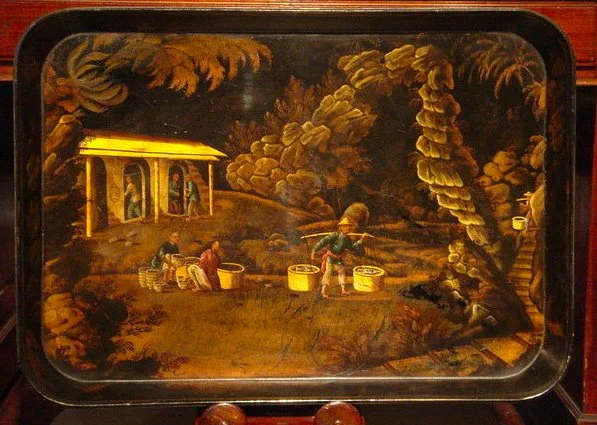
Depicting potters and carriers at a kiln in a wooded out crop Chinoiserie decoration on papier-mâche of this period is usually associated with the exotic style of the Brighton Pavilion, making English depictions of Chinese industry extremely rare especially on such a luxury item. Even more intriguing is the allusion to the ceramics trade on a tea tray, while clearly showing an English decorator’s ideas of Chinese faces and workers’ costume in contrast to the use of gold leaf and gold powder.
Circa 1820
Height: 18.5 in. (47 cm)
Width: 26 in. (66 cm)
Depth: 2 in. (5 cm)
£2,250

A truly magnificent and highly important five light candelabra in the late Regency manner, bearing the mark of Cadman, Roberts & Co. Sheffield, c.1827. Decorative motifs at the base of the central column and the underscrolls to the branches show adherence to designs in George Smith's 'Cabinet-Maker's and Upholster's Guide', (pubd. 1826) particularly Fig 1, Pl. XVIII among others, and those of Decimus Burton, notably in the detailing of fitments in The Atheneum Club, Waterloo Place, London, respectively. The combination of these with the Rococo Revival embossed decoration to the base visually confirm the circa date given. More precise date is made by the firm of Cadman, Roberts & Co becoming Smith, Roberts & Co in 1828.
Condition:- Some wear to show copper and base metal due to normal cleaning. Otherwise fine. Replaced handmade brass collar mounted glass hurricane shades to match fragments of an original.
Circa 1827
Height: 37½ inch / 95cm
Width: 20½ inch / 52cm
POA

An unusual Arts & Crafts period brass and copper tinder box. Of typical studded construction throughout, the front panel with raised oval lozenge below a domed hinged top, the inside with original removable liner.
Circa 1890
Height: 16" / 41 cm Width: 17" / 43 cm Depth: 14" / 35.5 cm
£750

A fine and striking model of a horse's head, hand forged and uniquely fashioned in textured bar steel by Charles Elliott for John Bly. Equally suitable for internal or external decoration. Charles was inspired by his wife's love and understanding of horses, and so created the horse’s expression to indicate a state of ‘fight or flight’, showing elements of fear but at the same time speed and courage.
A matching pair of smaller wall lights are also available.
Circa 2016
Height: 30 inch (76.20 cm)
Width: 23 inch (58.42 cm)
Depth: 21 inch (53.34 cm)
£6,500 plus VAT
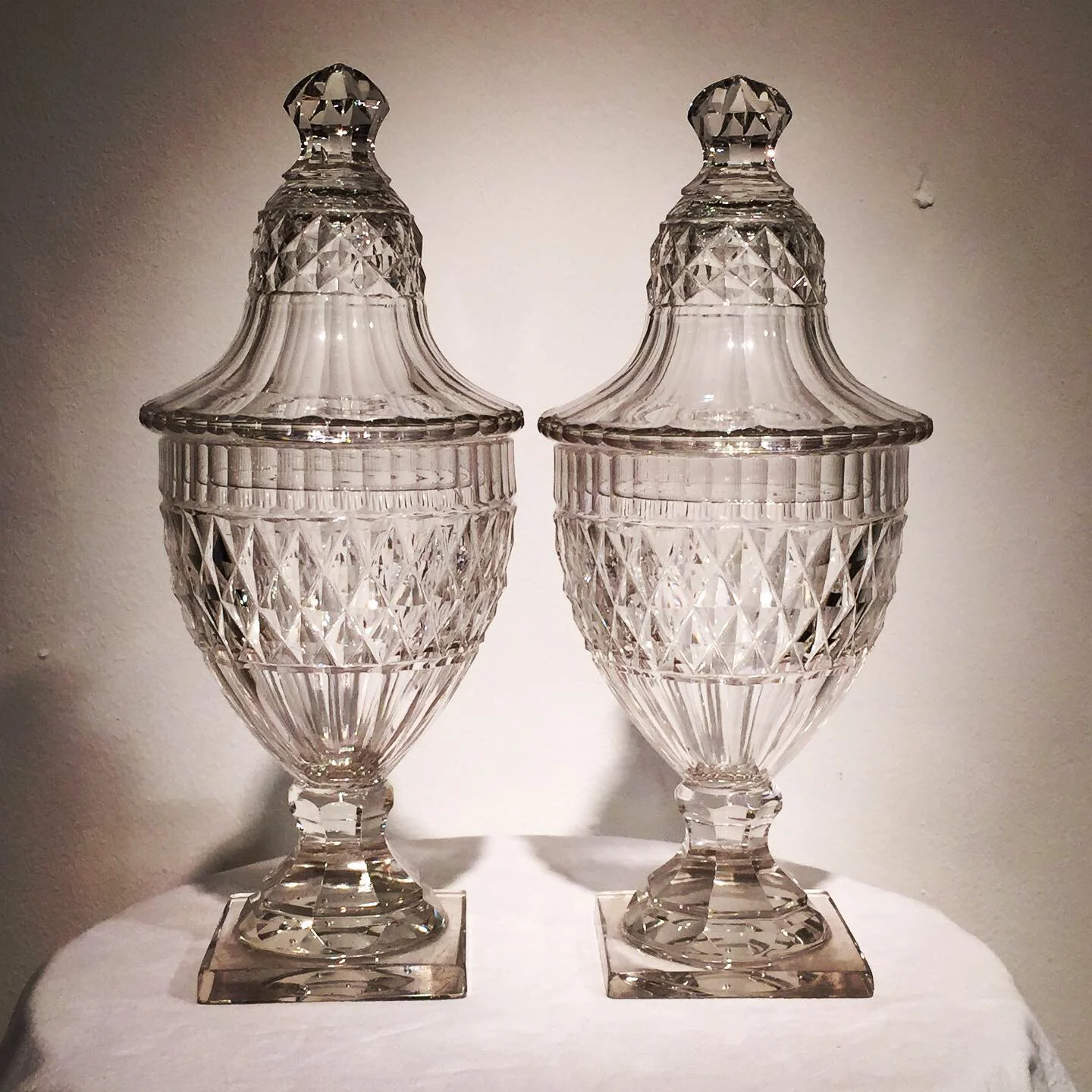
A Pair of 18th Century Cut Crystal Conserve or Sweetmeat Jars and Covers
This fine and rare pair of jars and covers are of the finest quality. The lids with crown cut knop handles, hobnail and facet cutting and scalloped edge, the jar as above on square bases. The 18th century lead crystal with fine grey hue as one would expect.
Circa 1785
Height: 11 inch (28cm)
Width: 4.75 inch (12 cm)
£2,500

The set comprising eight wine glasses, eight water glasses and six liquor glasses. All with extremely fine hand-painted gilt decoration. Each glass with a unique scene depicting an 18th century scene galante.
Circa 1920
Height: 6.5 inch (17 cm)
Width: 3.25 inch (8.25 cm)
Depth: 8.25 cm (3.25 inch)
£2,200
Available as boxed pairs, please enquire

A George III period steel trivet with a beautifully turned “vase” stem and pierced circular top on tripod legs. Made to hold plates or kettles but an ideal ice bucket Stand. Diameter of top: 7.75"/20cm.
Circa 1785
Height: 14.75 inch (37 cm)
Width: 11 inch (28 cm)
Depth: 11 inch (28 cm)
£750
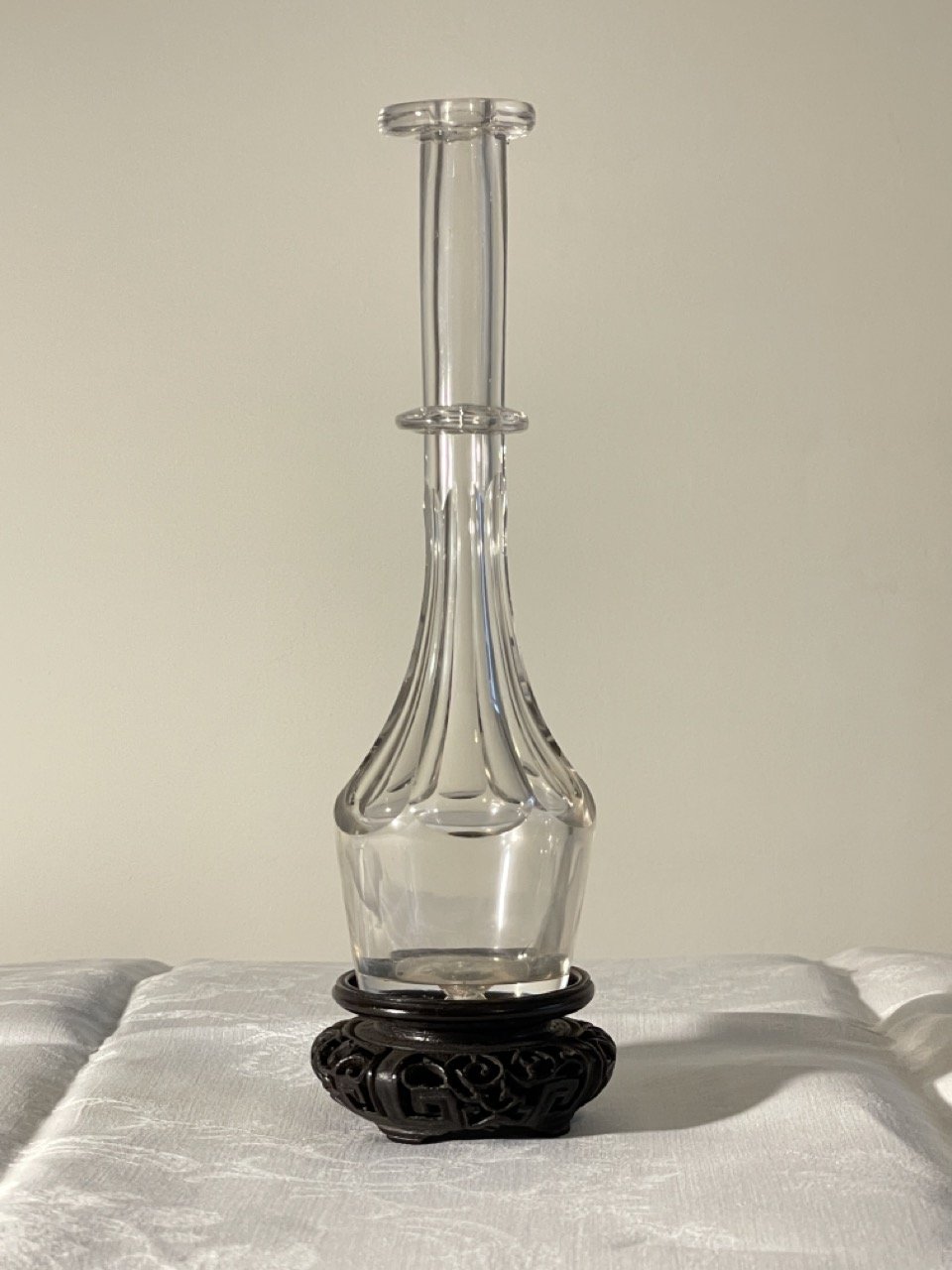
A good Georgian toddy lifter with flaired top, single ring and facet cut body.
Circa 1790
Height: 7 inch (17cm)
Widest: 2 inch (5 cm)
£125

A fine pair of mid 18th century mahogany Dutch torcheres. The shaped quatrefoil tops with moulded edge supported by double baluster shaped triform stems on tripod bases with cabriole legs carved at the knee terminating in ball and claw feet.
Circa 1740
Height: 35.5 inch (90 cm)
Top Width: 10 inch (25 cm)
Base Width: 17 inch (43 cm)
£3,250

Of turned and assembled wood, the exterior of the slightly everted sides with two raised circumferential rings, resting on three outward-facing bracket feet, the interior, the upper and lower bands of the sides and the legs lacquered red, the middle band of the sides with clear lacquer revealing the elm wood beneath.
16th-17th century
Height: 7”
Width: 13”
Depth: 13¼”
£250
Formerly from an American private collection, to Christies May 2013 and acquired through an agent by John Bly March 2024.

This wonderful pot and cover with diamond, facet and flute cutting throughout.
Fabulous colour.
Circa 1800
Height: 9 inch (22cm)
Width: 4.75 inch (12 cm)
£850
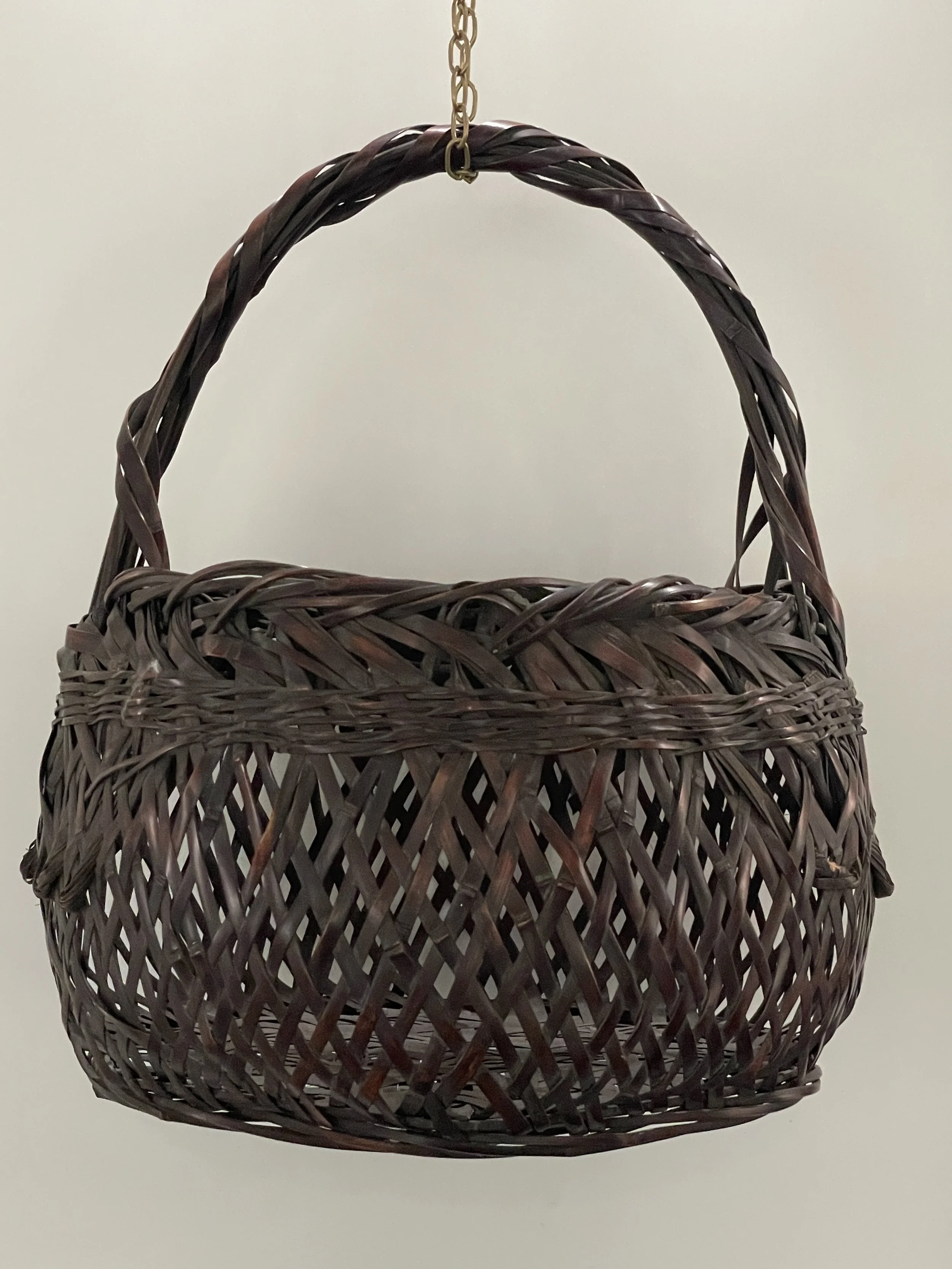
A woven basket with loop handle signed Sansei Shokosai Tsukuru (made by) Hayakawa Shokosai III, Taisho period.
Date 1915
The Hayakawa family is highly regarded when looking at the finest modern bamboo art in Japan. Hayakawa Shōkosai I (1815-1897) is said to have been the first to sign his works in 1856. His fifth son, Shōkosai III, took over the family business after the death of his elder brother, Shōkosai II, in 1905. Experts agree that he may have played the most important role in "expanding the expressive possibilities of bamboo, departing much further from Chinese models than his father." Reference: Joe Earle: Baskets. Masterpieces of Japanese Bamboo Art 1850-2015.
Bamboo groves are synonymous with the Japanese landscape, and crafting items from bamboo is one of the oldest technical skills in Japan. Skillfully crafted Japanese bamboo baskets have been used in Buddhist and tea ceremonies for centuries, initially evolved from craftsmen copying Chinese baskets brought into Japan in the 15th, 16th, and early 17th centuries. Master-apprentice lineages were established to pass skills down through the ages. During the twentieth century, individual artisans reinterpreted these traditions to create imaginative forms and vessels for flower arrangements. Credit: Tai Modern
Height: 13¼” / 34cm Diameter: 10½” / 27cm
£450
Formerly from an American private collection, to Christies May 2013 and acquired through an agent by John Bly March 2024.
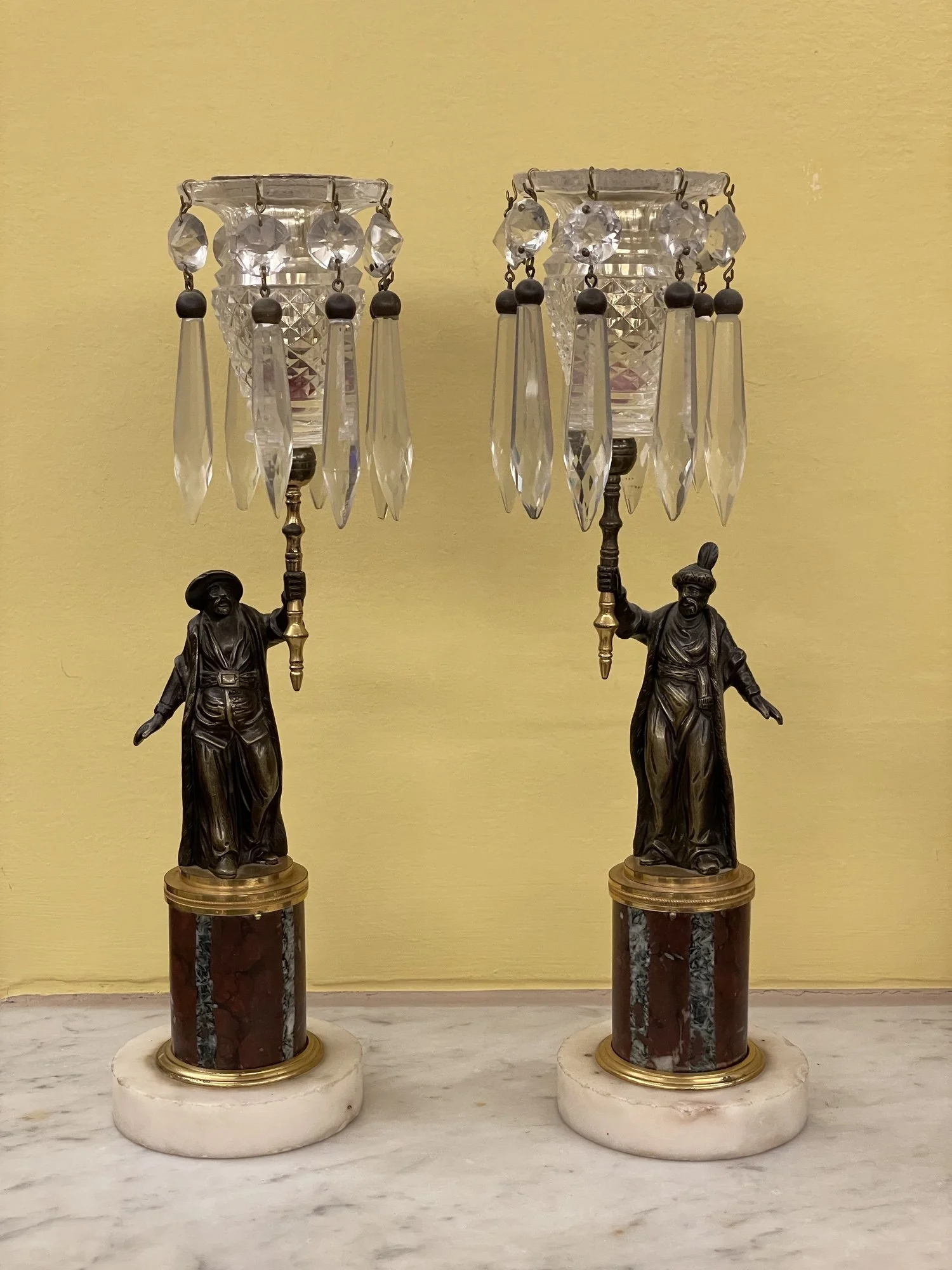
An attractive pair of Regency period lustre candlesticks; the cut glass sconces with original metal mounted drops supported by oriental robed bronze figures with combination marble and ormolu stands on white marble plinths.
Circa 1825
Height: 12½" Base diameter: 3½"
£1,250

A particularly fine example of an early 19th century cut crystal glass ale jug, with hobnail, facet and flute cutting to the body and star burst to the base.
Circa 1820
Height: 6¾ inch (17cm) Width: 7 inch (18cm) Depth: 5½ inch (14cm)
£350
Both home and garden come alive in the details, and this category is where those finishing touches sit. For indoors you will see a wide range of objects, from trays and table pieces to sculpture, glass, and conversation starters. For ornamentation in the garden there are vases and columns by Codestone, wrought iron bespoke figures, tables and chairs plus pieces for the conservatory. These are those special objects that add texture, sparkle, and intrigue, often with a story in the material or the making.
A charming early 19th century mahogany stand and jardiniere in the manner of Thomas King.
The top containing a tin liner supported by a ring turned stem standing on a triform base with bun feet.
The base and top with applied roundels, often incorporated by this designer's workshop.
Circa 1825
Height: 28" / 71cm
£2,750
Register interest
< BACK TO DECORATIVE & GARDEN